
January 2026
January 27, 2026
Crucifixion
Mark 15:16-32
For the Romans, the point of crucifixion was threefold. First, of course, was to put someone to death. Second, it was meant to serve as a deterrent for others who might be so inclined as to act in the same way that the crucified person had. And third, it was not only meant to cause death, but to also humiliate the person in front of family, friends, strangers, indeed anyone who might pass by the site. The Roman soldiers certainly do their part in promoting that humiliation.
The Romans, perhaps because they had so mistreated Jesus that he couldn’t carry the cross himself, compel a man from north Africa to carry the cross. Simon was apparently a member of a large Jewish community in north Africa. It is notable that both Egypt and Ethiopia became important centers of the early church.
Jesus is offered myrrh, a sedative, but refuses it. It is noted that Jesus was crucified at nine o’clock in the morning. Two other men are crucified next to Jesus, here described as bandits. And these two join in with passersby to continue the humiliation directed toward Jesus.
It was a horrible, inhuman means of punishment. Indeed, in the Gospel of Luke, which relates the story somewhat differently, the one man crucified next to Jesus proclaims to the other that although they deserve their punishment, Jesus has done nothing wrong. I don’t think anyone deserved such horrible punishment, but it is interesting that Luke provides for us the idea that Jesus was certainly innocent of any crime.
January 15, 2026
Collusion?
Mark 15:1-15
I will say right off that I struggle with this part of the Gospel story, from whatever Gospel it comes. The idea that Jewish leaders would consort with the Romans, no matter how offended they may have been at Jesus’s teachings, just seems beyond belief. Yet, for centuries, these stories have been taken at face value, and have often, across those centuries, led to violent anti-Semitism.
Crucifixion was a horrible means of death that the Romans used, meant in part as a deterrent used to keep their subjects in line, but also intended as a means of humiliation and disgrace inflicted through this awful means of putting someone to death. The Gospels speak of the crucifixion of Jesus and the other two men, but thousands of people were put to death in this way. It seems inconceivable that the Jewish authorities would want to encourage even one more crucifixion.
When the crowd calls for the release of Barabbas (which name literally means the “son of the fathers”), they certainly could have said, in regard to Jesus, “oh, just keep him in prison.” Why, here too, would they call for the crucifixion of a fellow Jew? It just doesn’t make sense to me.
That Jesus was indeed crucified is something about which there is no doubt. But it was the Romans who crucified him, and likely as a deterrent so that his followers would disband and any chance of an uprising would have been quelled.
We do still have this Gospel story, but how has it been influenced by events after Jesus’s death? It is a difficult question to sort out.
January 3, 2026
Art of Epiphany
On the second occasion when Alexi joined us in worship to create a work, she painted this amazing view of the journey of the magi.
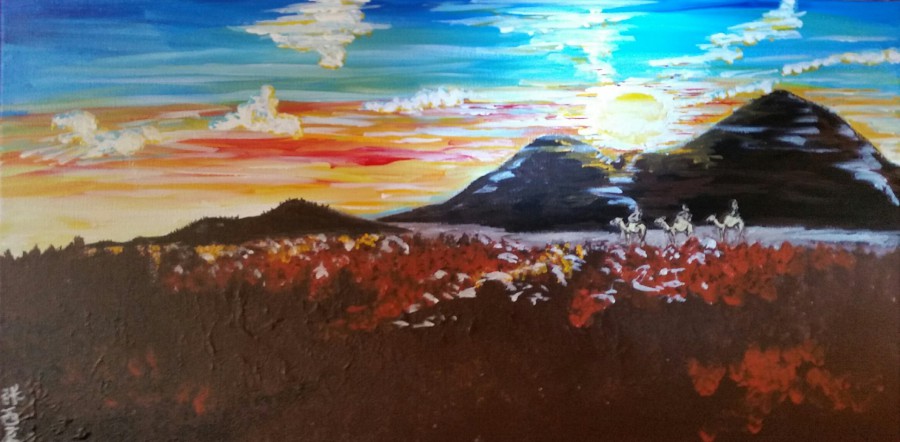
What I find intriguing about this painting is the several places where one’s eyes can focus, from the brilliant sun, to the striking red steaked across the sky, to the deep, rich brown in the foreground. There is of course also the focus on the three figures riding on camels, but they may not be the first thing that one sees. And that is part of the beauty of the painting, and of the story being told through the painting.
This was a journey for the magi. They no doubt went through many different types of terrain, and experienced many sunrises and sunsets. They were firmly committed to their trek westward. Yet, as the painting implies, they were a part of the bigger picture. When they arrived in Bethlehem, it was not so that others could be amazed at them, but so that they could offer their gifts to the holy family and look with amazement themselves at the child before them. Isn’t that where we hope we are led too?
While you can’t observe it from this view of the painting, the acrylics are also painted on the four sides of the canvas. Immediately after Alexi finished the painting, I suggested that I loved it and wanted to frame it for the church. She said that actually it was meant to be hung without framing, so that the painting is seen to continue beyond just the one surface. So, as I have thus never placed it into a frame, I have spent time reflecting upon the small ways in which it depicts where the magi have come from, and where they are headed. It then can also become a way of viewing what has come before in our own lives, and where we are headed as we begin the season of Epiphany.
 Print
Print 